The fast-food giant McDonalds has filed patent applications in Europe and the US that specify "the method and apparatus of making a sandwich". The apparatus boasts features that include “simultaneous toasting of a bread component” and inserting condiments into the sandwich with a “sandwich delivery tool.” The filling is placed in the ‘bread component’. For those of you who may be unfamiliar with the phenomenon of the sandwich, the patent application kindly explains that “Often the sandwich filling is the source of the name of the sandwich; for example, ham sandwich.”
The apparatus is designed to ensure the speedy production of sandwiches, in addition to uniformity of appearance. A diagram of the apparatus is available at: http://v3.espacenet.com/textdoc?DB=EPODOC&IDX=WO2006068865&QPN=WO2006068865
But before you cast your lunch aside for fear of a nasty encounter with a McDonalds patent attorney, the traditional, manual method of sandwich assembly is unlikely to be affected. Lawrence Smith-Higgins of the UK Patent Office said: "McDonald's or anyone else can't get retrospective exclusive rights to making a sandwich. They might have a novel device but it could be quite easy for someone to make a sandwich in a similar way without infringing their claims." McDonald's would not comment.
Saturday, December 02, 2006


Tuesday, November 14, 2006
Access to Medicine Ongoing Challenge for Poor

Oxfam has released today a Briefing Paper outlining how very little has changed to improve access to medicines since Doha. In the press release accompanying the publication, Oxfam says, "Poor people in developing countries are still being denied life-saving medicines five years after world leaders signed a formal trade declaration to put health before profits."
The Briefing Paper, entitled "Patents versus Patients: Five years after the Doha Declaration," maintains that trade rules continue to present a major barrier to genuine access to affordable medicines. The Paper describes patent protection as an ongoing obstacle to the delivery of cheaper generic versions to poor countries and calls for urgent action.
The Paper states "The Doha Declaration unequivocally recognises and clarifies that the TRIPS Agreement should not prevent WTO member countries from taking measures to protect public health," and "recognises the legitimate need of countries to take measures to reduce the price of medicines, such as using TRIPS safeguards." However, the "TRIPS-plus agenda" is seriously compromising the availability of such flexibilities and safeguards. In particular, the Briefing Paper criticises US trade policy and the emphasis on bilateral and regional free trade agreements as a way to ensure strong intellectual property protection despite the commitment to public health in the Doha Declaration. This is combined with what the paper describes as the indifference of other rich countries, where "all pharmaceutical companies selling medicines in a developing country, including European countries, benefit ... essentially 'free-riding' on US efforts to introduce TRIPS-plus rules."
The paper calls for new ways to promote patients over patents, noting the World Health Assembly Resolution of 2006 which established the inter-governmental working group. The World Health Organization (WHO) is tomorrow completing a public hearing in preparation for the meeting of the working group. Oxfam's paper focuses on several important cases, including the Glivec controversy.
The International Federation of Pharmaceutical Manufacturers & Associations (IFPMA) was reported in Reuters today as arguing that access to medicines is not the m
 ajor public health issue in the developing world, but rather inadaquate infrastructure. But Ellen 't Hoen of Medecins sans Frontieres (MSF) was quoted as saying "The current system based on patents and high prices to pay for innovation leads to rationing and leaves huge health needs neglected."
Oxfam is currently launching the Briefing Paper at BMA House in London, with highlights to be published at Patents vs Patients: Whose Rights Come First?
Saturday, November 04, 2006
Call for Papers - Special Journal Issue

Call for Papers
Special Issue September 2007
Intellectual Property, Medicine and Public Health
Deadline: 1 June 2007
Special Issue September 2007
Intellectual Property, Medicine and Public Health
Deadline: 1 June 2007
This is a call for papers for a special issue of SCRIPT-ed, entitled “Intellectual Property, Medicine, and Public Health”
Submissions of short analysis pieces (up to 1000 words), longer analysis pieces (approximately 1000 to 3000 words), peer-reviewed articles, and student papers are invited.
* access to medicines
* trade, bilaterals, and public health
* development
* gene sequences and patent law
* biopharmaceuticals
* patents and innovation
* data exclusivity
* stem cells
* property in human tissue
* genetic databases
* traditional knowledge and genetic resources
* more …
Informal enquiries may be made by email to the Guest Editor, Dr Johanna Gibson
Submissions by 1 June 2007 may be made by email to the Guest Editor, Dr Johanna Gibson or by mail to:
Dr Johanna Gibson
QMIPRI
Centre for Commercial Law Studies
Queen Mary, University of London
John Vane Science Centre
Charterhouse Square
London EC1M 6BQ
UNITED KINGDOM
Friday, November 03, 2006
WHO Public Hearing - Engaging the Private for Urgent Public Good
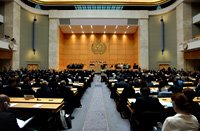
The World Health Organization (WHO) is currently conducting an online Public Hearing to collect data and proposals from various stakeholders and actors, towards an analysis of intellectual property rights, innovation and public health. Running 1-15 November, the Public Hearing will accept contributions from a wide range of stakeholders and actors.
The contributions to the Public Hearing will be collected for the first official meeting (4-8 December) of the intergovernmental working group (IGWG), convened under Resolution WHA59.24, "Public health, innovation, essential health research and intellectual property rights: towards a global strategy and plan of action." Resolution WHA59.24 was adopted at the 59th World Health Assembly, after consideration of the recommendations of the WHO Commission on Intellectual Property Rights, Innovation and Public Health (CIPIH), which concluded with its report in April 2006.
The IGWG is open to all interested Member States, and IP-Watch reports that the WHO will also invite a wide range of observers, UN organisations, intergovernmental and nongovernmental organisations, as well as experts and selected public and private entities.
The IGWG will collect the data and proposals from various stakeholders through this Public Hearing and prepare an analysis of intellectual property rights, innovation and public health, to be submitted to the 61st World Health Assembly, to be held in May 2008. This analysis will develop a global strategy for sustainable needs-driven health research and development, with particular attention to those diseases affecting developing countries.
Some of these major diseases are those caused by helminth infections. Earlier this month, the WHO published guidelines on Preventive Chemotherapy in Human Helminthiasis, examining large-scale prevention and treatment programmes in helminth infections causing schistosomiasis or bilharzia, diseases which are disproportionately high in developing countries. The manual sets out the new strategy to fight these infections, involving a partnership of more than 25 organisations. As well as a significant public health concern, the WHO has also identified serious considerations with respect to human rights, in that sufferers are often ostracised and stigmatised as a result of these infections and the effects on the body. In the accompanying press release to the publication, Dr David Heymann, WHO Acting Assistant Director-General for Communicable Diseases, said that treatment and prevention of these diseases is urgent and "incontestable from all perspectives: moral, human rights, economic and global public good. The task is feasible and must be done."
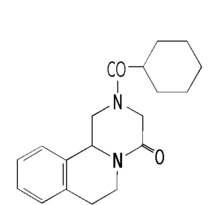
Pharmaceutical companies and private donors "make good the gap" in delivering the support to poorer countries, as reported in the Financial Times (FT) earlier this month. According to the FT, all the drugs required for these are diseases are donated, except Praziquantel (for the treatment of bilharzia, formula at right). Merck manufactures the drug, and Bayer markets the drug for veterinary use. WHO has been in negotiations with both for some time, but to date there had been no agreement to provide the drug.
However, Merck is now co-operating with the WHO towards the production by 2008 of drugs to treat bilharzia at less than half the market cost, following reports of increased "pressure" on Bayer and Merck to donate "for human use a drug they sell for pets." Professor Lorenzo Savioli, Director of the WHO Department of Control of Neglected Tropical Diseases, said to the FT that the renewed action and fresh requests to the companies are in response to "a real market failure because schistosomiasis affects the poorest of the poor. But Bayer tells us to talk to Merck, and Merck says talk to Bayer."
The FT reports that Merck was approached by the WHO early this year in Spring, but that supplies were presently too small and production costs too high to allow for a viable mechanism to supply the drug at the costs and quantities required.
The FT also reports that Bayer originally helped develop praziquantel with WHO support in the 1970s for the treatment of patients in Africa. However, Bayer concluded that it could not produce the drug so that it would be affordable. Bayer's public profile, much maligned following the GM contamination of US rice imports, is unlikely to be assisted by what the FT reports as its reluctance to participate in initiatives to achieve distribution of the drug in Africa.
Meanwhile, Pfizer is providing open access to its library of 3 million chemical compounds to WHO-affiliated researchers on tropical diseases. Initially, access was granted to 12 000 compounds for the treatment of helminth infections and related concerns. The intellectual property rights arising from such programmes, however, are not clear, as no decision has been made on what will happen to any promising developments.
Tuesday, October 31, 2006
UK R&D Scoreboard 2006 - GSK Lifts UK R&D, But Size Does Matter
The UK Department of Trade and Industry (DTI) has just released the figures for the 2006 R&D scoreboard.
The R&D Scoreboard 2006 provides information on the top 800 UK and top 1250 global companies based on R&D investment. The meaning of R&D for the Scoreboard is found in the UK in the Standard Statement of Accounting Practice (SSAP 13), which defines the concept based on the different definitions used by the Organisation for Economic Co-operation and Development (OECD) Frascati manual on expenditure for research and development. For global companies the International Accounting Standard (IAS 38) is used, also based on the Frascati manual.
The SSAP provides the definition of expenditure falling into one or more of the categories of pure or basic research, applied research, and development. The third category is particularly relevant to associated measurements of patent activity, in that it covers the "use of scientific or technical knowledge in order to produce new or substantially improved materials, devices, products ..."
72 UK companies made it into the Global 1250, with an increase in UK R&D expenditure (including 245 foreign owned companies) to £19.2bn (£17bn in 2005). This has been attributed to greater disclosure as well as an increase in R&D, which is particularly strong in pharmaceuticals in the UK. The previous decrease in UK 800 expenditure (1% decrease in 2005) has been replaced by an increase of 4% in 2006. GlaxoSmithKline (GSK) reported one of the larges, at £297million.

But others have criticised the increase as "distorted," pointing to the new accounting rule that insists on greater levels of disclosure in sectors not traditionally driven by or associated with R&D, such as banking. DTI senior industrialist and lead author of the report, Mike Tubbs (pictured right), in a report in The Independent, said "For the first time we had R&D from these companies. We knew they did R&D but we did not know it was that much." But a report in The Times suggests instead that "Britain is losing ground."
The Scoreboard for the Global 1250 shows that the pharmaceutical sector (along with software) is one of the fasting growing sectors with highest profitability. But it is second place in R&D, just behind technology hardware, putting 6 pharmaceutical companies in the top 20 (compared to none just 10 years ago). However, the number of patents granted per £10million is much lower than those for technology hardware and electronics.
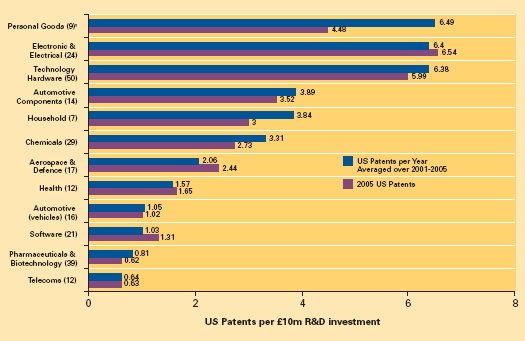 The patent-to-R&D ratio for 12 sectors
Although the centenarian, GSK, is now the second-largest pharmaceutical company in the world (behind Pfizer), but a report in today's IP-Watch suggests that there is a distinct market advantage for small and medium-sized pharmaceuticals (SMEs) when it comes to neglected diseases and diseases in developing countries. Reporting on a seminar at the headquarters of the World Intellectual Property Organization (WIPO), co-organised with the Stockholm Network, IP-Watch notes the importance of "creative licensing deals" and cooperation with larger pharmaceutical companies. On patenting, Nikolaus Thumm, senior economic counsellor of the Swiss Federal Institute of Intellectual Property, told the meeting that there is a need to correct the "common misunderstanding" that the stronger the protection, the more innovation.
Thursday, October 26, 2006
Free Public Workshop - London, 13 November 2006
Criminal Enforcement Directive
Let the Punishment Fit the Crime?
Let the Punishment Fit the Crime?
The Patenting Lives network will be conducting a free public workshop on the proposed European Directive on criminal measures aimed at ensuring the enforcement of intellectual property rights (Criminal Enforcement Directive).
The workshop will commence with a discussion by a panel of experts, looking at the possible implications of the Directive for patentable technologies and patent practice.
Expert Panellists
Gwilym Roberts, Partner, Kilburn & Strode Patent Attorneys
Julian Heathcote Hobbins, Senior Legal Counsel, FAST (Federation Against Software Theft)
Phillip Johnson, Barrister, DTI Legal Services, Legal Adviser to the
(Chair Johanna Gibson)
The workshop is FREE but numbers are limited, so please register by email to Johanna Gibson.
This is the first in a series of Patenting Lives public workshops on current issues in patent law. Stay tuned for more to come.
For more details on the Patenting Lives project and network, please visit patenting lives or the patenting lives blogWednesday, October 25, 2006
Competition Inquiry into Johnson / Pfizer Deals
The European Commission has commenced a competition inquiry into Johnson & Johnson's planned acquisition of Pfizer's consumer health interests.
The Commission's Competition Directorate will decide at the end of next month whether the sale can proceed or whether a full-scale investigation is warranted. If the latter route is taken, this will delay the process by a further 90 days.
The proposed deal was announced in June this year and will result in Johnson & Johnson having a substantial monopoly over consumer health products. Jonathan Todd, speaking for the Commission's Competition Directorate, was quoted in an article in The Times saying, "Our concern is whether or not there may be an adverse effect on consumers, pricing and competition."
Earlier this month it was reported that US anti-trust regulators forced Johnson & Johnson and Pfizer to agree to sell Zantac (to Boehringer-Ingelheim Pharmaceuticals, for US$509.5M), after there were concerns that this product overlapped with some Pfizer products.
Meanwhile, as reported in the Financial Times last week, Lloydspharmacy has asked the Office of Fair Trading (OFT) in the UK to investigate Pfizer's exclusive agreement with UniChem to act as a single distributor for its drugs in the UK. UniChem is part of Alliance Boots, which also runs the large rival pharmacy chain, Boots.
Pfizer cla
 ims that the deal is to control the supply chain in a fight against counterfeit drugs, but after the expiration of patent protection for several of its key sellers - including Zythromax (antibiotic), Diflucan (antifungal), and Zoloft (antidepressent) - the agreement seems to be equally about limiting competition from cheaper, generic versions. Other British pharmacies and drug distributors are concerned that this will lead to an anti-competitive monopoly, adversely affecting consumers with higher prices. According to a recent report in the Financial Times, Pfizer's drugs account for around 15% of the UK's £10.3 billion pharmaceutical market. Furthemore, pharmacies will be forced to use UniChem as the exclusive provider of Pfizer's branded drugs, leading to concerns that Pfizer will be able to control the discounts available to retailers as well.
James Harding, in an opinion piece in the The Times, suggests that public scrutiny will exonerate Pfizer, but he is correct to note that important questions being asked, "Is Pfizer just hyping up the counterfeits argument in order to cut out competition and take control of pricing?" and "Will UniChem provide as reliable a service to other pharmacies as it does to its own Boots stores?" In other words, the Pfizer-UniChem agreement will in effect control each level of the chain, right down to the deals with individual retailers themselves. By "taking a risk," Harding seems to think Pfizer is exonerated. But surely that is the nature of the entrepreneurial business models - taking risks pays much higher dividends. It is not clear that the risk of Pfizer grazing a knee if UniChem stumbles will be a sufficient check and balance against the potentially anti-competitive nature of this deal.
The British Association of Pharmaceutical Wholesalers (BAPW), the main trade body in the UK, is likely to make a similar complaint with the OFT. The Chairman of BAPW, Ian Brown
 lee, said to The Times, "With a single supplier the delivery system cannot ensure that pharmaceutical products are there in the dispensary when they are needed. Profit is being put before patient safety with a breathtaking arrogance." UniChem is one of its members.
Subscribe to:
Posts (Atom)


