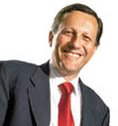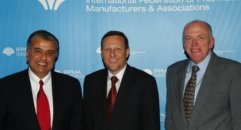
At the recent
23rd Assembly of the International Federation of Pharmaceutical Manufacturers & Associations (
IFPMA), held in Geneva, it was announced that a new code of marketing ethics is to be launched next year, according to a
report in
IP-Watch. But current events possibly raise questions as to how effective any code might be in the face of what is sometimes described as the litigation "business model."
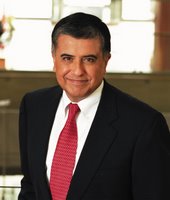
Presenting a keynote to the meeting, Mr Fred Hassan (pictured at right), Chairman and CEO of
Schering-Plough and the
new President of IFPMA, declared that IFPMA has made significant progress on marketing and clinical activities. He noted the voluntary guidelines developed and used in the US, and explained that implementation is now more important than strategies.
On clinical trials, Mr Hassan noted the IFPMA initiative in delivering public information. Earlier this year, IFPMA
launched the second stage of the
Clinical Trials Portal, developed with
IBM. According to the background information provided by IFPMA, the aim of the service is to facilitate public access to pharmaceutical clinical trial data. The portal will operate as an internet search engine, allowing patients to locate information to clinical trials, both completed and in progress, and is sponsored by originator (as opposed to generic) pharmaceutical companies around the world. The portal searches the listings (registries) of on-going clinical trials and the results of completed clinical trials. IFPMA maintains that the presentation of results is "in a standard, non-promotional, summary format."
The 1st Stage of the Clinical Trials Portal was launched in September last year, but the Stage 2 upgrade allows greater functionality, including search criteria in French, German, Japanese, and Spanish, as well as the original English of Stage 1. The 2nd Stage also offers a more advanced search function as well as the use of the MedDRA and MeSH medical dictionaries to provide multilingual synonyms.
In his keynote, Mr Hassan importantly identified 4 significant obstacles to improving health care: "barriers to access," "barriers to innovation," regulatory systems, and the "barrier to openness, transparency and accountability." To overcome the first obstacle, Mr Hassan argued for improved access to health education and information as well as new interventions. On the latter, however, the critical obstacle was seen to be administrative, including that of regulatory delays (in the approval and registration of new drugs), and practices with respect to patent monopolies were not really addressed. Indeed, in comments on "barriers to innovation," intellectual property was described as "the engine of innovation." Mr Hassan argued that "only a handful of countries contribute the innovation that drives improved health care throughout the world. The US carries a disproportionate load." The new President looked to "Private entrepreneurship and risk-taking, in open markets" as the mechanism to improve innovation and resource allocation and said the "the protection of intellectual property" is "absolutely critical."
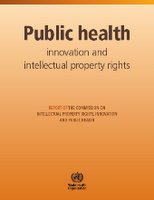
Indeed, earlier this year, in response to the first report of the World Health Organization (
WHO) Commission on Intellectual Property Rights, Innovation and Public Health (
CIPIH). The
Report, entitled
Public Health: Innovation and Intellectual Property Rights, generated a strong
response from IFPMA, which expressed concern that the Report "surprisingly recommends that developing countries should make use of compulsory licensing," and criticised the Report as underestimating the role of patents. Ellen 't Hoen, from Medicins sans Frontieres (
MSF) Access to Essential Medicines
Campaign, however,
welcomed the report. Writing in the
WHO Bulletin, she described the report as presenting "a wealth of evidence and analysis in support of the view that the current system of drug development is fundamentally flawed and leaves huge health needs unmet."
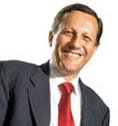
Mr Hassan succeeds Dr Daniel Vasella (pictured left), Chairman and CEO of
Novartis and IFPMA President 2004-2006.
Novartis has come under criticism lately, in its challenge to Indian patent law. Novartis had obtained exclusive marketing rights for 5 years for its cancer drug,
Glivec (marketed as
Gleevec in the US) a temporary monopoly until the Examiner submits a report on the invention (
Patents Act, Chapter IVA). However, because it was decided that the invention was not an invention, the exclusive marketing rights were withdrawn. The application failed for lack of inventive step (obviousness) because it was a new form of a known substance. The refusal (analysed in an
article by Manisha Singh Nair) was made on a number of grounds. But a substantial basis was provided by Section 3(d) of the Indian Patents Act, which provides that "the mere discovery of a new form of a known substance which does not result in the enhancement of the known efficacy of that substance" will not be sufficiently inventive to warrant patentability. In other words, India is refusing to allow Swiss-type claims.
Under the
2005 amendments to Indian patent law (to become TRIPS compliant), every application for exclusive marketing rights is treated as a request for examination. Further, any person or group may now file a pre-grant opposition. In this case, the
Cancer Patients Aid Association and several generic pharmaceuticals (including
Natco) did so in the
Chennai patent office, on behalf of cancer patients.
In response, Novartis filed in May 2006, claiming that Indian patent law is unconstitutional and also contravenes international trade rules, taking the complaint to the Madras High Court, which sits in Chennai. A press officer from Novartis, speaking to
IP-Watch, described the action as evidence of "Novartis' strong commitment to defending international intellectual property standards and its right to obtain patents for its innovative compounds under the World Trade Organization Agreement on Trade-Related Aspects of Intellectual Property Rights (
TRIPS)." Daniel Vasella also spoke to IP-Watch, saying that the litigation was "a question of principle," and that unless Novartis pursues this it "would undermine the whole system."
According to
Reuters, Novartis is claiming that Section 3(d) is not TRIPS-compliant. However, Article 27(1) of TRIPS arguably does not go so far as to mandate the protection of new use, or to define what a country must protect as an invention. It simply says, "all fields of technology, provided that they are new, involve an inventive step and are capable of industrial application." The exclusions relate to subject matter (methods, plants and animals) and such exclusions are included in the European Patent Convention (
EPC),
Article 52. On the other hand, a Swiss-type claim is a known product. It could be argued that this therefore forms the state of the art, and therefore Swiss type claims may be refused by countries on the basis that they are not new. Indeed, Swiss type claims are dealt with under Section 2(6) of the
UK Patents Act 1977, further indicating that they are a matter of novelty. The Indian Act, however, excludes "new use of a known substance" in Section 3, "What Are Not Inventions."
The Berne Declaration (
BD), a Swiss non-governmental organisation, has made a statement that section 3(d) is in compliance with TRIPS. Further, BD
states that each member is entitled to introduce a patent regime compatible with its socio-economic context provided they are compliant with the minimum standards of
TRIPS (Art 8), a view supported by the 2001 Doha Declaration on TRIPS and Public Health (
Doha). The BD cites the
WHO CIPIH Report as supporting this view. On page 34, the report states: "countries may devise their patent systems to seek teh best balance, in their own circumstances, between benefits and costs. Thus developing countries may determine in their own ways the definition of an invention, the criteria for judging patentability ... provided these are consistent with the relevant articles of TRIPS." Further, the report importantly states that, "Under TRIPS
they may also exempt from patentability ... new indications of known products which amount to a therapeutic method."
Ellen 't Hoen said to IP-Watch, "This has
South Africa written all over it" and has said in an MSF
press release, "If Novartis' challenge against the Inidan patent law is successful, a key safeguard that can protect the production of affordable medicines will be lost." As the Times of India has
reported, the cost of one month's supply of Glivec is Rs 1.10 lakh (Rs 110 000), whereas a generic equivalent is available for Rs 1100.
Civil society organisations in Switzerland, led by BD, have sent an
open letter to Mr Vasella, in which 22 organisations and personalities demanded the withdrawal of the legal action. Those endorsing the letter includeed
MSF Suisse,
medicuba, Association of European Cancer Leagues (
ECL),
CO-OPERAID, and, in a private capacity, Mrs Ruth Dreifuss, former Swiss cabinet minister and Chairperson of the
CIPIH,
WHO. But in response to the letter, John Gilardi of Novartis has told
swissinfo that "It's important that we applaud the efforts India has made to improve its intellectual property protection, but this is about ensuring that a patent for Glivec, which is recognised in over 40 countries, is also recognised in India." According to the article, Mr Gilardi claimed that Indian patent law clearly exceeded the flexibilities available. Along the lines of Mr Hassan's statement that intellectual property laws are the "engine of innovation," Mr Gilardi told swissinfo "Without a reward for innovation, there will be no innovation."
The
IFPMA meeting also included a
keynote presentation by
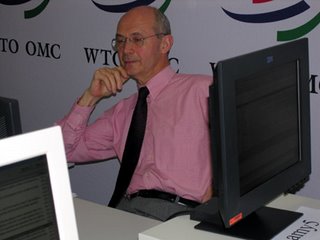
Pascal Lamy Director-General of the World Trade Organ

ization (
WTO) (pictured at left, speaking at the
6th Ministerial Conference, Hong Kong,
NGOs Roundtable Forum). Mr Lamy has recently spoken on the "
bilateral disease" of free trade agreements, and the EU's troubling emphasis on bilateral deals. In his address to IFPMA, Mr Lamy said "I am convinced that there is no acceptable alternative to completing the Doha Round." As recently reported in the Financial Times (12 Oct, "WTO head flags trade rules"), Mr Lamy told the meeting that the WTO had not received a single notification of a developing country issuing a compulsory licence, suggesting that the current flexibilities are too complex to be used in practice. "To be frank," he said, "I see that as a problem."
The
WHO CIPIH Report has also noted the "emerging development" of the "growning number of bilateral and free trade agreements which include higher standards of protection that erode these flexibilities" considered earlier. And even EU business is wary of bilaterals. Speak
ing at
UNICE, Michael Treschow, President of the Confederation of Swedish Enterprise, recently told the Financial Times (18 Oct, "Ericsson chief warns EU") that "It is not countries that do business with countries but companies that do business with companies."
Peter Mandelson, European Commissioner for External Trade, defended bilaterals and rejected stories of his "clash" with Africa-Caribbean-Pacific (ACP) countries in an
address to the European Socialist Party Conference on Economic Partnership Agreements, last Thursday. This is despite recent press that ACP countries will reject trade deals with the EU. In an article in
FT Europe,
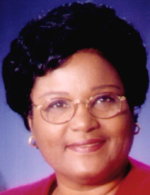
Dame Billie Miller (pictured at right) Barbados trade negotiator, criticised Mr Mandelson's emphasis "economic partnership agreements" as pure trade negotiations. She said, "For us the development dimension is critical. We made our concerns known but the Commission has continu
ed to talk the talk."
Pascal Lamy hosted an
online chat last Wednesday, attracting around 150 questions on the Doha Round and the future of the WTO. The many questions in the
transcript include discussions on multiculturalism in trade, life patents, controls on bilateral agreements, and the future of the Doha Round.
 imply resulting in proxy advertising for the pharmaceutical industry. Secretary General of the Pharmaceutical Group of the European Union (PGEU), John Chave (pictured at right), is not convinced of the need for the legislation: "If, however, the laws are to be changed, it is of fundamental importance that public confidence in the integrity of the information provided is maintained. The pushing of information by the industry should never be a proxy form of promotion or advertising. The sole justification for change can only be to help patients and not to grant more commercial freedom to the pharmaceutical industry." In its submission to the public consultation, the PGEU identified problems with self-regulation in the industry, among other concerns.